Building from the Ground Up: A Conversation with Ismail Samad on Cultural Preservation, Power and Possibility in East Cleveland
Updated: Apr 30
Introduction: Radical Presence in East Cleveland
In a moment when phrases like ‘community engagement’ and ‘creative placemaking’ are widely circulated but often shallow in practice, Loiter emerges as a radical intervention. Based in East Cleveland, a city long impacted by redlining, deindustrialisation and infrastructural neglect, Loiter isn’t a typical non-profit, a gallery, or a consultancy; it’s a philosophy of presence. Founded on principles of cultural preservation, refusal of erasure, and long-haul solidarity, Loiter reclaims space for the people who have remained in East Cleveland, busy doing the work of everyday life on the ground.

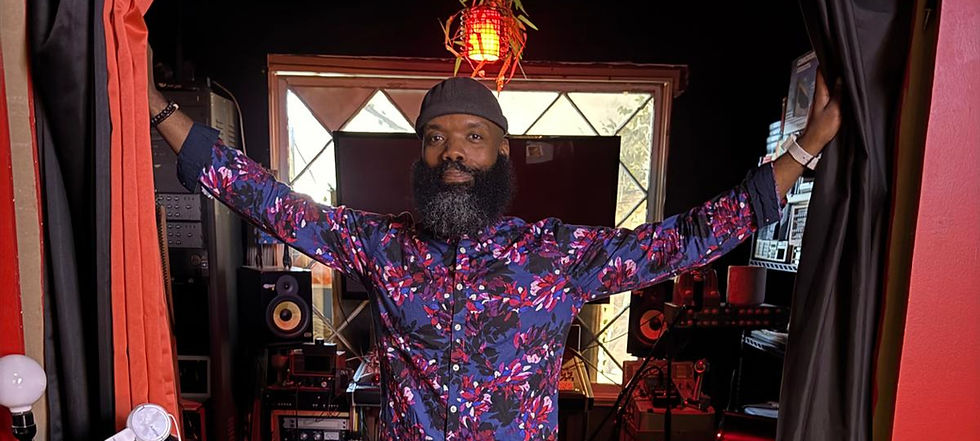
In this conversation, we hear from one of Loiter’s founding practitioners, Ismail Samad.
Samad’s voice is sharp, unsentimental, and deeply grounded in local knowledge. Over the course of the interview, he speaks about extractive development, legacy residents, slow organising, and what it means to stay rooted in a place that is often overlooked, doing work that is challenged when it becomes noticed.
Samad typically brings about conversations exploring what he calls ‘unprincipled policies’. He asks, ‘How do we set principled policies in place when the holders of the power and influence are the ones who are shaping the desires of expansion?’ He notes that when you deal in systemic change, you either align with palatable forms of development or you become construed as a threat.
On power and development: ‘How do we set principled policies in place when the holders of power and influence are the ones shaping the desires of expansion?’
Samad notes an opportunity for acquiescence, to take up mainstream forms of activity that still feel adjacent to transformative change, dealing in standard economic development strategies, but resists this mode.
Rather than a polished manifesto, what follows is an urgent, open-ended transcript where culture, politics, and survival intersect.
On Development, Gentrification, and Cultural Erasure
You speak powerfully about culture, space, and development. Especially as someone returning to East Cleveland, what happens when development begins from the outside?
IS: The first wave is always aesthetic. In Cleveland, like most cities in America, that means someone starts a community garden. It sounds beautiful. But it’s often led by younger, ‘hipster’ folks, people who have the means and privilege to engage their wokeness in ‘local’ food culture. And that activity becomes a signifier of safety. There are studies. Crime drops, they say. Then comes the farmers' market, the café.
From my perspective, American culture is defined by consumption. We not only consume, but we also project that model outward, encouraging others to replicate, scale, and adopt it. Every decision, from policy to public movements, tends to align with these cultural norms. It affects choices around preserving culture, expanding influence, and even investing in the arts. If something isn’t tied to the dominant value of scalable profit, it’s often not seen as valuable by those who control cultural delivery.
We’re loosely talking about gentrification as a commoditising force here. What gets lost in that process?
IS: What's lost is the identity of the community that was left there to steward and toil away, ignored for so long. And if you don't value energy, right, if you don't acknowledge existing energy and resources, if you just ignore the fact that a tree exists and chop it down to make way, you're ignoring the beauty and means of life of the community that was living in its shade.
On gentrification and loss: ‘What’s lost is the identity of the community that was left there to steward and toil away, ignored for so long.’
We lose the perspective of the existing culture that's not manicured or manipulated to fit an outsider's perspective and business plan?
Yes, we skip over everything that existed before: the folks who were already tending to that space, who never got asked to the table. The deep roots. The organic, lived culture. The stuff that doesn’t make headlines. You lose the unspectacular but vital practices of care and survival.
That culture gets erased, not because it isn’t valuable, but because it doesn’t translate into gentrifier logic. Yes, there’s the opportunity for co-op membership, I can be part of a farm-share, that café happens, but it’s all defined by the folks that are moving into the community, usually.
We skip over the reason why the investment didn’t happen in this target area in the first place. And the reason, as you said, is those invisible lines of racism. Concurrent with this shift is the narrative, external opinions, and commoditisation of scaling the business of ‘improvement’, a culture-washing of systemic inequity.
In the context of traditional economic development, scale needs to happen. We witness the sanitisation of what already existed, without pausing to consider the losses of those whose energy sustained it. Human beings are expendable in the context of extractive capitalism.
If people genuinely want to support communities like East Cleveland, what should they be doing instead?
IS: Start by acknowledging who’s already doing the work. People like Ed Parker. He’s held space here for decades. When early-stage conversations about redevelopment started, he wasn’t invited. That’s not an oversight. That’s erasure.
On redevelopment and exclusion: ‘When early-stage conversations about redevelopment started, he wasn’t invited. That’s not an oversight. That’s erasure.’


Loiter as Framework and Practice
You’ve introduced the idea of Loiter as a framework. Can you explain what that means?
IS: Sure. Loiter is our project and philosophy. The name comes from loitering laws used to criminalise Black presence. We’re reclaiming that. Loitering is about lingering, staying, holding space, especially when the systems don’t want you there. We’re not rushing to produce. We’re staying long enough to understand, to connect, to build culture without extraction.
On Loiter’s core approach: ‘We’re not rushing to produce. We’re staying long enough to understand, to connect, to build culture without extraction.’
I try to develop theories through practice. It's gotten me to the point where I believe that small cities in the United States can move differently than big cities. In the same way that you have ethos-based policies that are dominating the headlines as it relates to national politics, I think that suburbs that are predominantly Black, that have been historically intentionally divested from and cut off from the larger adjacent cities because of white flight etc, can set their own charters, to move in ways that preserve and develop a predominant ethos that the legacy residents are interested in.
I’m talking about a municipalist point of view, a minimalism through socialism. How might we create a principles-based narrative and policies that are attached to home rule, setting charters, and looking at legislation through a local democratic process? I'm interested in trying to disrupt the current model, respectfully.
So Loiter is about local presence as resistance, and change?
IS: Exactly. Loiter is a place and a concept. It’s a physical manifestation of what people have been dreaming and talking about. You have to actively talk about dreams as well as being radically pragmatic about where we are as relates to power. We look out for the realities. What skin in the game do you currently have? What are you able to put in now? And are you bought in? How will you fundraise? In a standard way, that's kind of what Loiter is.

Evolving art walls along Loiter's Ambition Alley.
We take Loiter’s provocative name from the Jim Crow era, where three Black folks walking down the street together could be arrested for congregating. That threat remains connected to current loitering laws. It goes against the concept of spatial justice. Just being human beings and existing together is policed. Deep barriers still exist to organic, collective gathering, rooted in a past where simply existing together was criminalised. I'm just hanging out. I got nowhere to go. And even if I had somewhere to go, there are deeply resistant narratives working to counteract our ability to plan and dream together. You can’t build a community without loitering.
Refusing Hope, Claiming Reality
Saying Black Lives Matter doesn’t mean that they do. In the context of America, they don’t, and we shouldn’t lie to ourselves about that. It does not work to claim power that you do not have because then you cannot negotiate based on the facts, the actual realities. Leveraging hope is a disruptive language that whitewashes and commodifies the process.
Putting a campaign out around hope is problematic. And that's not saying I'm not super hopeful. I'm ridiculously optimistic, but the campaign itself is not hopeful. It's just real. Loiter isn’t about ‘hope’ in a shallow sense. We say: ‘Hope is a drug. We don’t sell it. We don’t buy it. We don’t use it.’ We’re not here to sugar-coat. We’re here to do the work—slow, relational, sometimes uncomfortable. Loiter is an anti-extractive practice that prioritises rootedness and refusal.
On rejecting false hope: ‘Hope is a drug. We don’t sell it. We don’t buy it. We don’t use it.’
Circular Economies, Food Justice, and Community Stewardship
We've got an ice cream company. Ben, who runs the Splice Cream Truck, drives around, captures the stories of folks and puts them on wax. We’re about to launch a facility designed to capture recyclable plastics, which we’ll use to produce our own records. Read more about Ben's artistic practice, here.
We also run a fermented food company that transforms waste products into kimchi, packaged in reusable glass jars that people can return to us. In these efforts, we’re not focused on traditional education around littering or civic pride. Instead, the act of recycling directly supports the cause. It connects the community to a circular economy, one where waste doesn’t end up as litter on the ground but becomes part of something meaningful and sustainable.

When we open up our full café, we'll have our own principled policies. There's zero single-use plastic allowed in this space. If you bring back your jar, you get 50 cents off, because we're gonna use it again, produce the product and sell it in the grocery stores that you know and walk to. People become connected. They're incentivised to caretake the land on which they walk. And so the square mile we’re inhabiting becomes the cleanest area in East Cleveland.
On circular economy and care: ‘People become connected. They’re incentivised to caretake the land on which they walk.’
Policy, Power, and Local Transformation
You’ve mentioned East Cleveland as a unique site for policy change. Why here?
IS: Because the governance scale is small enough to matter. With just five city council members, three votes can shift local law. That means we could write a charter centred on legacy residents, people who never left. We could implement land trust holdings, alternative zoning, public power, all with community-first logic.
On local power: ‘With just five city council members, three votes can shift local law.’
Rust-belt cities like Cleveland used to be major players of the Industrial Revolution. The fact that Rockefeller used to live in East Cleveland and a President is buried here means that the value of East Cleveland is forever pinned to the map. You cannot ignore the fact that it is here and that it exists.
The first billionaire lived in and left East Cleveland, leaving behind a lasting legacy. The city was also home to the first industrial park, located at Nela Park, with General Electric. Three craters on the moon were named from an observatory right here in East Cleveland.

This rich history must be preserved, alongside the contributions of African Americans, who, through generations of toil, have become the city’s majority population, an extremely rare reality in American cities. I believe East Cleveland has the potential to transcend traditional politics and become a place where authentic community flourishing is truly possible.
And you see arts and cultural memory as part of that strategy?
IS: Absolutely. Black culture is one of America’s most powerful exports, and yet, we don’t control the archive. Loiter is about protecting our own narratives. The music, the block clubs, the corner stores, the dances, we hold all of that close. But we don’t always own it. That’s what we’re changing.
What about the sense that people don’t vote or engage?
IS: That’s not apathy, it’s protest. If East Cleveland has 10–12% turnout, that’s not a failure of civic duty. It’s a message: ‘This isn’t for us.’ People aren’t disinterested, they’re disinvested in the status quo. Loiter doesn’t shame them. We meet them. We show up. Trust takes time.
And how do you hold that trust?
IS: By not selling out. A lot of non-profits chase grants instead of mission. They dilute the work. We don’t do that. We say no. Loiter is small on purpose. We’d rather hold a room with ten people who care than stage something performative for a hundred who don’t.
This is the reality of working with people feeling inertia, who are not able to take part in the change in their own communities. On the one hand, how do we engage with and amplify community voices and dreams, and on the other, how do we root them in live pragmatism? For example, how do I engage with you, personally, in an on-the-ground conversation about Loiter’s zero single-use plastic principle without excluding you because you can't afford compostable products? That's the conversation.
Conversation as Art, and the Power of Staying
You describe conversation itself as art. Why is that?
IS: Because dialogue is a practice. This, what we’re doing now, is the work. We don’t need a gallery to legitimise it. These conversations shape memory, politics, ethics. They surface the unspoken. That’s artistic labour too.
On conversation as practice: ‘This, what we’re doing now, is the work. We don’t need a gallery to legitimise it.’
We ran a series of critical community conversations. One of those focused on art-washing, another on gentrification, and one was titled, ‘We've Been Here, How Do We Stay Here?’ They explore what ‘the why’ of the work is for us. I'm not interested in ‘the what’ of the work, for me, the ‘what’ is always the ‘why’. The work is not led by a focus on producing a product. To me, this, the form of conversation we are having, is the expression of beauty: engagement, inquiry and curiosity, the quality of process. Needs are not served by a pop-up. The answer is not an installation or a graffiti wall. It's not any of that.
So Loiter becomes both a space and a method?
IS: Exactly. It’s a refusal to disappear. It’s a commitment to stay, to question, to build. We’re not interested in being on trend. We’re here for stewardship. And if that makes us slow or difficult, so be it. We’re not trying to be the next big thing. We’re trying to be the thing that lasts.
A Principled, Place-based Practice
In a landscape crowded with performative gestures and short-term fixes, Loiter offers something far more enduring: a principled, place-based practice rooted in presence. Through conversation, reuse, policy, and care, Ismail Samad and his collaborators model a path of resistance, one grounded not in spectacle, but in sustained, invisible labour. Loiter isn’t just a project or a space; it’s a commitment to listen, to stay, and to build with, not for. It asks us to redefine development and reconsider who gets to lead it. Real change starts not with a campaign, but with a conversation and the courage to remain.
Loiter shows us that culture isn't just what we produce, it's how we persist. If you want to support communities like East Cleveland, start by showing up, listening, and staying long enough to matter. Stewardship, not spectacle, is what lasts. Don’t ask what the community needs. Ask what it’s already doing and reflect on why you weren’t paying attention. Then ask how you can make space, shift power, and get to work.
On persistence: ‘Stewardship, not spectacle, is what lasts.’
Read more about Loiter’s Community Wealth Hub here.


Comments