A Paradise of Displacement
Updated: Apr 22
From participation to co-production: care, memory and the making of civic space
Each year, Ingenuity Cleveland transforms its large industrial site into IngenuityFest 2025: a weekend of art, performance and experimentation. In September 2025, A Paradise of Displacement was introduced within that setting.
Alongside the festival’s performances and installations, A Paradise of Displacement introduced a set of participatory works that asked a simple question:
What happens when people are invited to author their own cultural record?

from 'I See You', a Quest 4 the Fest activation within A Paradise of Displacement
What this project was
A Paradise of Displacement brought together four connected installations:
Office of Public Memory: documenting what is being forgotten or erased
Station Hope: short, public reflections on belonging and survival
The Land Acts (“I Stand For…”): statements of values and commitments
Map of Care: a spatial record of where care exists across the city
Each activation approached the same question from a different angle. The Office of Public Memory functioned as a temporary counter-archive, inviting people to record places, rituals and cultural moments they felt were disappearing or had already been lost. Station Hope shifted the focus to the present, collecting short, public reflections on belonging, movement and survival: what people are carrying, and what they wish to bring into their vision of community. The Land Acts (“I Stand For…”) expanded this into a collective declaration of values, where participants articulated personal and political commitments in their own words. Finally, the Map of Care grounded these ideas in place, asking people to locate where care, support, and community already exist across the city, and where they are needed most.
Together, they formed a loop:
Memory → Voice → Values → Place
Across three days, more than 1000 contributions were gathered. This wasn’t just participation. It was a form of counter-archiving, a way of producing knowledge outside institutional systems.
As Ariella Azoulay notes, most archives are not neutral; they can act as “agents of exclusion”, shaping what is remembered and what is left out.

Visitors to A Paradise of Displacement mapping out memories of their childhood homes and experiences.
Why this matters
Much of the research informing this project starts from a simple premise:
Cultural erasure is not accidental, it is structured.
Thinkers such as Achille Mbembe and Azoulay show how power shapes visibility and presence, determining what is preserved and what is allowed to disappear. Seen this way, everyday memory of venues, rituals, language and relationships is not incidental. It is politically significant. This project doesn’t just document that memory. It treats it as a grounding infrastructure.
What we saw
One of the clearest outcomes was how quickly people engaged.
1000+ contributions
4 activations
3 days
People didn’t need much instruction. The prompts were simple, the formats accessible and the responses immediate. Just as notably, people spent time with what others had written: reading carefully, lingering, sometimes returning to the same contributions more than once.
The installations became spaces not only for expression, but for attention.
This aligns with a key idea running through the research: knowledge is situated and embodied, not abstract. People respond with nuance when they are asked in ways that connect to lived experience, and when they are given the space to recognise themselves, and others, within it.
Pattern 1: Care is the dominant language
Across all four installations, the same themes appeared repeatedly.
From the 'I Stand For…' dataset:
Love & Belonging        ██████████████████████ 36.7%
Care & Mutual Aid       ████████████████████  34.2%
Agency / Selfhood       █████████████████     32.0%
Education               ███████████████       28.2%
Peace / Solidarity      ██████████████        25.6%
People wrote:
“Only you define you.”
“Love your neighbor like you mean it.”
“Be a proof of a positive environment.”
“Solidarity forever.”
Care here isn’t abstract or sentimental. It functions as what María Puig de la Bellacasa describes as a “material and ethical practice”, something that sustains life in conditions where formal systems fall short.
Takeaway: Care is not secondary to civic life, it is a primary organising principle.

'I Stand For...', a Quest 4 the Fest activation within A Paradise of Displacement
Pattern 2: Memory is contested and actively rebuilt
At the 'Office of Public Memory', participants documented what should not be forgotten:
Vanishing venues & third places   ████████████████████ 28%
Food & rituals                    ████████             ~10%
Arts & culture                    ███████              ~9%
People named:
closed music venues
demolished gathering spaces
family traditions
neighbourhood rituals
Many responses were highly specific—naming exact sites, moments, and experiences. Taken together, they form a distributed record of loss, especially around the spaces and practices that support everyday social life.
Takeaway: Memory here is not nostalgic, it is protective and political.
Pattern 3: People think in systems
Responses rarely focused on a single issue.
Instead, people combined:
mental health + justice
education + democracy
environment + equity
This reflects what Donna Haraway calls “situated knowledge”, understanding that emerges from lived complexity rather than isolated categories.
Takeaway: People already understand that social issues are interconnected, even when institutions treat them separately.
Pattern 4: Care has a geography
The 'Map of Care' translated these ideas into space:
Hope        ████████████████ 26.5%
Love        ███████████████  24.3%
Assertion   ██████████       16.9%
Courage     ████████         13.2%
Resistance  ████████         13.2%
Care clustered in:
parks
cafés
arts venues
waterfront spaces
But these clusters were uneven. Some neighbourhoods showed dense networks of care. Others surfaced more themes of resistance and survival. Urban theorists have long argued that cities are not neutral, they are shaped by power, access, and exclusion.
Takeaway: The map reflects both where care exists and where it is harder to access, where care is already happening, and where it isn’t. The quieter areas are just as important: they point to where spaces, resources and collective activity have been lost or are under pressure, and where new, community-led initiatives could take root.
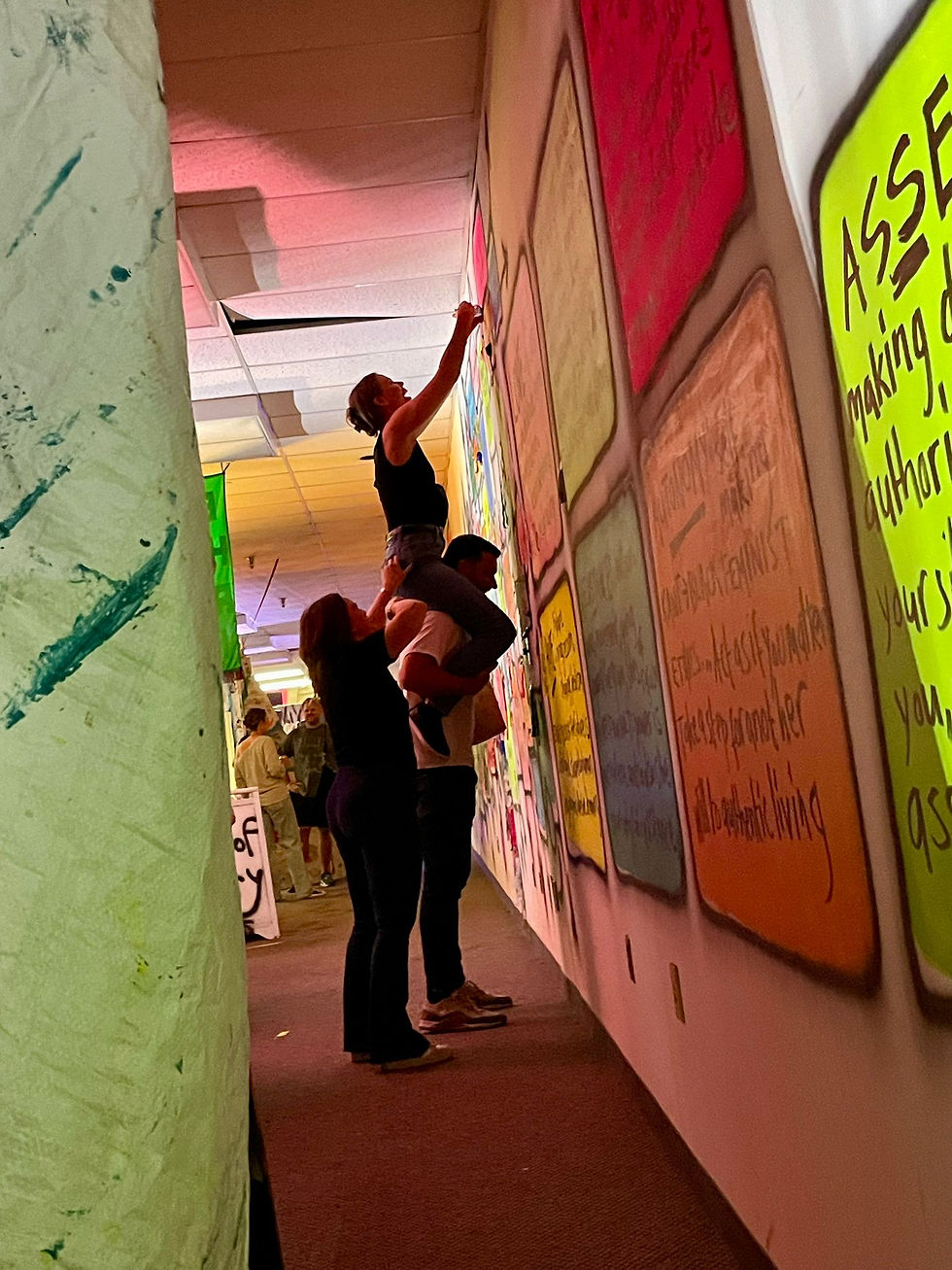
'Map of Care': Visitors to A Paradise of Displacement mapping sites of love, hope, courage, resistance, assertion and autonomyin Cleveland.
Pattern 5: Visibility matters
One of the more unexpected findings:
People signed their names.
Assertion (signatures / place-claims) ██████████ 16.9%
This aligns with the idea that cultural participation is not only about expression, but about presence. In contexts where visibility is unevenly distributed, naming yourself becomes a form of agency.
Takeaway: Cultural participation often seeks to bypass anonymity and is frequently about being recognised. Naming oneself is a simple form of representation, a way of asserting presence within a shared space. It begins to shift participation from contribution to co-production, where people are not just adding input but actively confirming they have shaped the record, and by extension, a desire to shape the systems of care that emerge from it.
The tensions
The data also revealed contradictions.
Care vs. structural insecurity
People called for:
kindness
support
mutual aid
But also referenced:
stress
instability
survival
As Isabell Lorey describes, insecurity is often produced, not accidental. Care is filling gaps that systems leave open.
Strong places vs. uneven access
Care clustered in areas with:
active, designed public space
central cultural infrastructure
accessible amenities
Elsewhere, responses focused more on:
resistance
protection
survival
Belonging is shaped by spatial inequality.
Expression vs. recognition
People used:
humour
slang
multiple languages
coded references
These forms carry meaning, but are often excluded from formal systems of knowledge.
This reflects a broader issue: whose voices are considered legible or valid.
What stood out
Three things were particularly clear:
1. Participation is not the barrier
When formats are accessible, people contribute quickly and in large numbers.
2. Low-tech methods work
Handwritten and drawn responses produced detailed, nuanced data without digital infrastructure.
3. This is more than engagement
People didn’t just respond, they:
connected ideas
mapped systems
contributed to a shared archive
This aligns with Nicolas Bourriaud’s idea of art as a “social interstice”, a space where new forms of relation and knowledge can emerge.

Quest for the Fest activities within A Paradise of Displacement included live portraiture ('I See You'), development of a community quilt and jar displays of cultural ingredients the Cleveland community wish to preserve. Also featured, banners from Aram Han Siefuentes' Protest Banner Lending Library.
Why this matters
Much of the literature on cultural inequality focuses on critique, how institutions fail.
This project tests something else:
What happens if you build alternatives instead?
There is often a gap between critique and practice-based infrastructure.
This work begins to fill that gap by:
generating community-authored data
identifying real sites and priorities
creating a basis for future action
beginning with lived experience as expertise, and working with simple, accessible resources that lower the barrier to participation
What comes next
The next phase builds directly from what people shared.
At IngenuityFest, A Paradise of Displacement surfaced clear themes: care, belonging, mutual aid, cultural memory and civic voice. It also raised a practical question: how do these insights move beyond collection and become shared activity, repeated over time?
One speculative answer has been Are We Not Strangers?, a participatory performance and storytelling framework developed as a “rehearsal for empathy” and a test of what more intentional, care-centred gathering might look like.
Beta-tested at Cleveland Public Theatre's SoftLaunch 2026, the work invited small groups into a structured encounter built around attention, listening, items of everyday ephemora, books as slow, contemplative thinking and shared speech. As the script describes it, the piece was conceived as “a stabilising framework [...] a test and a catalyst to a broader body of future community theatre activity in which public voice will evolve further.”
This matters because it marked a shift in the work: from gathering public contributions to testing how people meet; from archive to encounter; from expression to co-presence.

Are We Not Strangers?
Image: Emmanuel Wallace
In Are We Not Strangers?, the emphasis was not on spectacle or character, but on relation itself: how a room can be held, how attention can be shared and how participation can move people from passive spectatorship toward what Augusto Boal would call more active, collective presence.
The performance asked audiences to practise small acts of connection under quiet, deliberate conditions: to handle objects, exchange notes, read together and consider what it means to be present with strangers. In that sense, it functioned as both artwork and prototype: a further test of the social forms that this wider body of work is trying to build.
The next step is to move that testing into neighbourhoods.
With Making Room, the work shifts into St. Clair–Superior, Ingenuity's home district, where the focus becomes building repeatable, resident-led spaces for gathering, listening, reflection and action.
If A Paradise of Displacement asked what people remember, value and need, Making Room asks what it takes to create space for us to individually and collectively activate the potential of these things in everyday life.
This phase centres co-design and co-production through:
story circles and shared tables in familiar venues
walkshops shaped by residents’ own routes and landmarks
pop-up story booths for consent-based gathering and reflection
street essays that return community language to the public landscape
forum and legislative theatre sessions where neighbours can rehearse responses to everyday gaps in care
Here, the aim is not simply to invite participation, but to build local capacity for hosting and sustaining it. Residents are supported to become story stewards, citizen archivists, facilitators and co-designers of the work itself.
This means developing not just events, but the consolidation of local mutual-aid and cultural support systems: lightweight structures for meeting, listening, documenting, sharing back and staying in relationship. These practices underpin community-led placemaking, supporting the conditions for residents to shape their own environments and to participate more directly in civic design conversations, particularly through participatory and legislative theatre, where lived experience can be translated into collective proposals and action.
This leads toward Here Is Where We Meet at IngenuityFest 2026: a larger public activation shaped by what has been learned in St. Clair–Superior and carried by the people helping to make it. Rather than treating the festival as an endpoint, the intention is to use it as a relay point, bringing neighbourhood-led practice into wider visibility, testing co-produced formats at a larger scale, and then returning that energy back into the neighbourhood.
Across these phases, the direction of travel is becoming clearer:
listen → test → co-design → share back → sustain
In practical terms, that means:
developing 3–5 place-based pilots rooted in local sites of care, absence and encounter
building a Care & Culture Atlas that tracks stories, relationships and neighbourhood assets over time
creating public action loops, “You Spoke → We Did This Together”, so that participation is met with visible response, accountability and cumulative shared agency.
What began as a set of participatory installations is becoming something more durable: a neighbourhood-based practice of representation, co-design, co-production, and mutual aid.
The question is no longer only what people shared.
It is how to make room for those voices to design and shape what happens next.
Final note
One of the simplest findings is also the most important:
People already hold knowledge about their city: its gaps, its strengths, its possibilities.
The challenge is not collecting that knowledge. It is recognising it, and building with it, together.


Comments