Black Classical: What Composition Emerges When a City Listens to Itself?
Updated: Sep 3
Benjamin Smith’s evolving multidisciplinary practice brings together listening, portraiture, sound, print and the material traces of place to ask how a community might compose and transmit its own cultural life.
What composition emerges when a city listens to itself?
This question sits at the center of Black Classical, an evolving body of work by East Cleveland-based artist, musician and community practitioner Benjamin Smith. Developed through the project Little-Bit, the work gathers voices, portraits, conversations, music and material traces of East Cleveland, bringing them into relation without resolving them into a single account of the city.
Its starting point is deceptively simple.
What brings you joy?
Over a series of encounters on the streets of East Cleveland, Smith asked residents this question. Twenty-five people took part in the first iteration of Little-Bit. Some answered in a few words, others opened into stories. They spoke about children, spouses, parents and friends; faith and survival; making other people smile; waking up each morning; music, peace, love and belonging.
Individually, these are fragments. Together, they begin to behave differently. They become a score.
A Little Bit of Attention
Little-Bit: Economies of Attention begins from the proposition that attention has value. The project is less concerned with producing a definitive portrait of East Cleveland than with creating conditions for people to encounter one another differently. A little bit of listening. A little bit of time. A little bit of money. A little bit of curiosity. A little bit of care.
Participants are recognized for the time, knowledge and presence they contribute. Their encounters do not disappear into a research archive but become part of a growing system of recordings, portraits, printed matter, music and transmission.
This is important to Smith’s wider practice. Rather than approaching participation as a means of extracting stories, Little-Bit asks what happens when cultural value is allowed to circulate: when something offered can be transformed, returned, encountered by somebody else and set in motion again.
The first Little-Bit portraits were made on the streets of East Cleveland using vintage gaming systems. Their deliberately restricted resolution reduces faces to fields of digital information—pixels and color blocks hovering between abstraction and recognition. The technology slows down the act of looking. Recognition does not arrive all at once; it has to be assembled through engagement.
Little-Bit: Economies of Attention, 2026. A growing series of portraits, voices and encounters made with residents across East Cleveland. Beginning with the question “What brings you joy?”, Little-Bit uses vintage gaming technology, sound and conversation to gather fragments of everyday life—building an evolving portrait of place through attention, exchange and relation.
The accompanying conversations operate similarly. There is no single testimony that explains the experience of living in East Cleveland. Meaning accumulates between voices.
The resulting portrait is therefore distributed rather than singular: a collection of small signals that becomes richer the more closely we listen and look. The Black Classical book describes Little-Bit as an ongoing project in which small acts of listening, conversation and reciprocity accumulate into a collective portrait of East Cleveland.
Black Classical
From this process emerges Black Classical.
The title carries its own lineage. Nina Simone resisted the limits placed upon her music by conventional genre categories, describing what she made instead as Black Classical Music. Classically trained and originally intent on becoming a concert pianist, Simone moved between Bach, blues, gospel, folk, jazz and popular music without accepting that this breadth should diminish the seriousness or cultural status of Black musical practice. Her own description reclaimed “classical” from its assumed synonymity with a white European canon, asserting a Black musical tradition with its own rigor, history and capacity for continual invention.
Smith’s Black Classical takes up that proposition in East Cleveland. The title does not describe a genre so much as an orientation toward Black cultural production: one in which music, speech, memory, sociality and everyday acts of invention can all constitute compositional knowledge.
Here, composition expands beyond one medium.
A conversation can become compositional material. So can a portrait, a damaged wall, an architectural fragment, somebody laughing, somebody remembering, or the exchange that takes place between two people on a street.
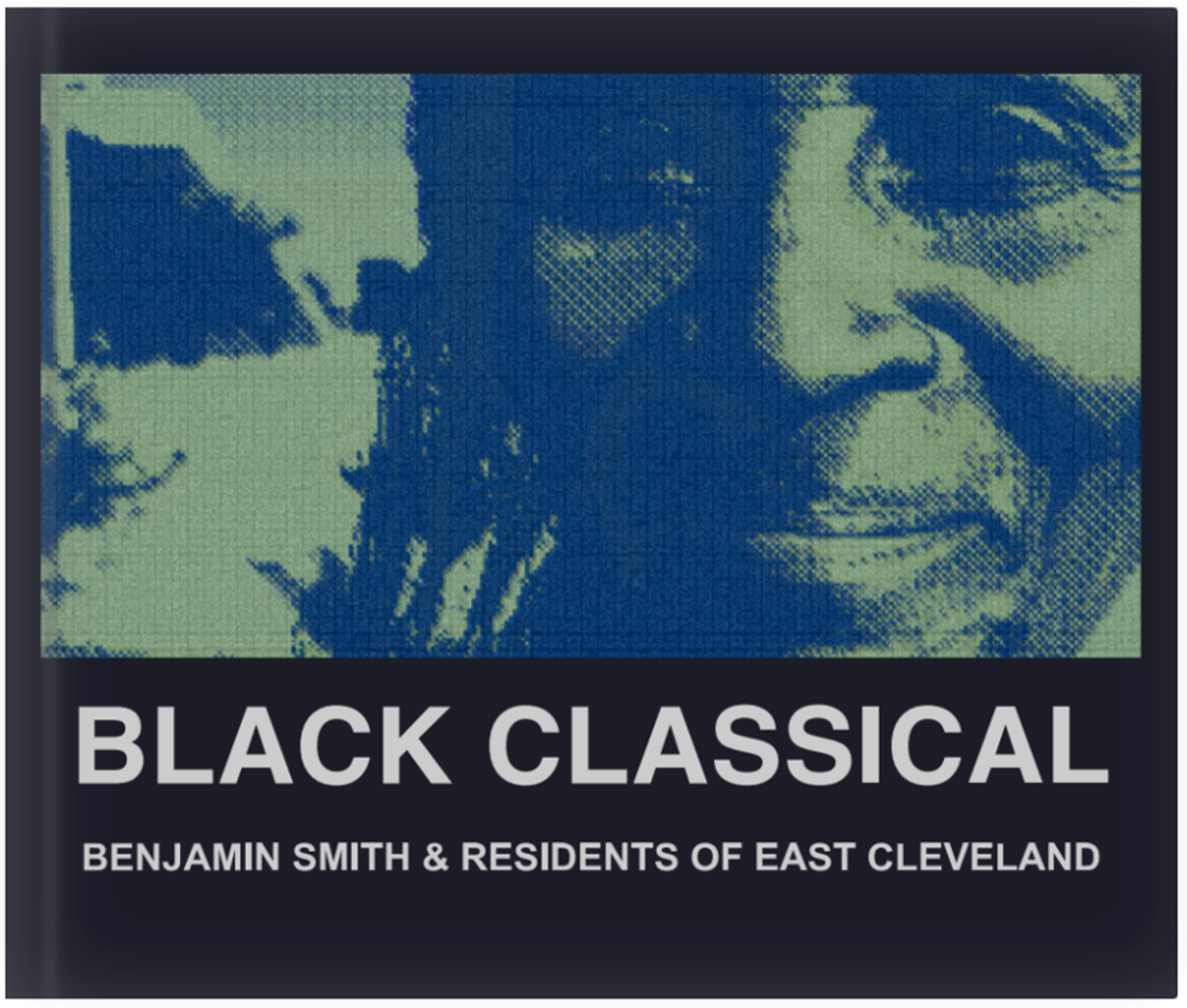
The artist’s book at the center of Black Classical is conceived as a printed musical score. Across its pages, Smith’s pixelated portraits of East Cleveland residents are placed alongside fragments of their conversations, and photographs of the cleared land and former homes on Chapman and Elderwood Avenues.

Black Classical, 2026. Detail of the artist’s book, conceived as a printed musical score. Pixelated portraits of East Cleveland residents appear alongside fragments of conversation, photographs of the city and images of former homes on Chapman and Elderwood Avenues, accumulating across the pages as voices, images, rhythms and traces of place.
The book identifies itself simply as “a love song to East Cleveland and the people who compose it.” Those words are important: the people do not simply appear within the composition. They generate it.
The publication makes this relationship visible. A resident appears; a building intervenes. A question returns somewhere else. Another encounter changes its register. Faces move through different visual systems. Streets and domestic interiors establish their own rhythms and pauses. No single image is asked to represent East Cleveland as a whole.
Instead, the work accumulates.
After Toni Morrison’s Jazz
Black Classical describes itself as coming “after Toni Morrison’s Jazz.” The relationship is not just thematic. Smith is interested in what happens when some of Morrison’s literary strategies are translated into the materials of social practice, sound, portraiture, print and installation.
Music is inseparable from Morrison’s writing. Nicholas F. Pici describes Jazz as a novel that effectively “breathes” the rhythms and cadences of jazz, with musical thinking operating through its language, structure and content. Musicality is the fabric of everyday for Smith, a bridge or the matrix of art and life.
More significantly for Black Classical, Morrison described the novel as deliberately drawing upon the characteristics of jazz itself. Improvisation allows unanticipated things to happen. Multiple voices prevent one perspective from dominating. A narrative or melody can establish itself, disappear, be played against and eventually return in altered form.
Smith relocates these principles into East Cleveland. One encounter sets something in motion and another changes its direction. A face returns in a different register; speech becomes rhythm; architecture cuts into portraiture; individual testimony remains unresolved against what surrounds it. Like a jazz ensemble, coherence comes not from making every contribution agree, but from allowing distinct parts to occupy the same compositional field.
Morrison’s Jazz repeatedly understands the city itself through music. It is a place of sound moving between people and buildings—a “City seeping music that begged and challenged each and every day.” The music cannot easily be contained; it enters domestic life, moves through streets and produces response.
Morrison’s thinking is especially pertinent because her understanding of Black aesthetics extended beyond musical imitation. She wrote of antiphony, improvisation, the group nature of art, audience participation and the relationship between individual expression and communal values. She does not reduce the reader to a passive observer but as someone who must be given space to participate in the work.
Black Classical takes that participatory proposition literally. The score is not finished.
Making a Clearing
In fall 2026, Black Classical enters a new context through A Clearing: Word, Image, Body, a group exhibition co-curated by Anthony Huffman and Scout Bach as part of Ohio Celebrates Toni Morrison at Zygote Press, Cleveland.
Taking its conceptual starting point from the clearing in Morrison’s Beloved, the exhibition considers what it might mean for artists to craft spaces for other ways of seeing, being, relating and imagining within—not outside—the conditions that already affect us.
For Smith, that question is inseparable from place and the activity of being in the world.
East Cleveland is not simply the subject or backdrop of Black Classical. Its streets, architecture and material histories enter the composition alongside its residents.
Former homes on Chapman and Elderwood Avenues have become particularly important sites within the work. Photographs, from collaborator Naomi Lord, repeatedly place the interiors and remains of these buildings into dialogue with portraits of residents: a charred corridor beside a pixelated face; an empty room beside another; a view through a broken window entering the sequence like a pause in the score.

Naomi Lord, 14841 Elderwood Avenue, 2026. Photograph documenting the fire-damaged interior of the East Cleveland house, looking through its open roof to the sky.
Architectural remnants from these sites extend beyond documentation into the physical installation. Charred material becomes support, surface and evidence: the material history of a place entering into relation with the living voices and images around it.
Morrison writes in Jazz, “I didn’t fall in love, I rose in it.” The distinction feels important. A clearing need not represent escape from the conditions surrounding it; it can be a space made within them from which something else might rise. Love, relation and collective possibility become ways of being rather than destinations. And, yes, whilst we may happen upon a clearing, it is also in deep within our power to craft the cathedrals we need with whatever means are available to us.
Seen this way, the clearing is not empty ground awaiting occupation. It is the groundswell within us, already resonant with potential—with histories, voices, relations and possibilities that may become perceptible if we listen deeply enough to their profound lessons and allow them to rise up.
From Score to Resonant Space
The printed score extends into sound and space.
In the gallery, Black Classical expands the book into a spatial composition. The installation brings Smith’s pixelated portraits and recorded voices into relation with vinyl records, sound, vintage audio technologies and architectural remnants gathered from former homes in East Cleveland. Listening stations allow different elements of the work to be encountered separately and together, while images, objects and material traces move the score off the page and into the room. Rather than presenting a linear narrative, the installation creates a field through which visitors move, making their own connections between resident, voice, music, architecture and place.

Judy, in Passage, 2026
Chapman Avenue, East Cleveland, Ohio
An element of the Black Classical gallery installation.
Image by Naomi Lord.
Records produced through RSVP — Recycled Shared Vinyl Press, Smith’s developing community record label and recording infrastructure, bring residents’ voices and music into a layered sonic composition.
Examples of record sleeves from Black Classical, 2026. Pixelated portraits of East Cleveland residents extend across the vinyl format, carrying the visual language of the artist’s book into the recorded elements of the expanded work.
The musicality of Morrison’s Jazz offers a way of understanding this movement. Riffs provide foundations from which improvisation can depart and return; call and response requires one musician to listen closely enough to another to answer, provoke or redirect what has already been offered. There is a paradox of holistic resonance emitted from the shifting, shimmering shape of collective creativity: the continuous feedback loops and fluid activity of listening, imagining and making together.
The relationship extends beyond musicians to listeners. In jazz performance, audience response can itself alter the musical exchange, creating a matrix of interaction between performer and observer.
Black Classical asks what such a structure might mean beyond the bandstand. What if a city remembers is operates as an ensemble? What if its conversations, images, memories, buildings and relationships could be heard not as disconnected evidence about a place, but as contributions to an unfinished composition?
Morrison’s own description of Black aesthetic practice is useful here: art as improvisational and communal, dependent upon a participatory relationship between maker and audience. Smith extends that relationship outward so that listening is not something that happens after the composition has been made. Listening is one of the ways it is made.
A Love Song to East Cleveland
There is a risk whenever a place such as East Cleveland becomes the subject of cultural attention that its complexity is compressed into familiar narratives of decline, abandonment or resilience.
Little-Bit begins elsewhere.
It begins with joy.
Not because joy cancels difficulty, but because asking what brings someone joy changes the terms of attention. It asks what people value, whom they love, what sustains them and what they recognize as meaningful in their own lives.

Returning to a refrain—“I didn’t fall in love, I rose in it”—the distinction takes on further significance here. A clearing is not an escape from the broader conditions to which we are subject, but something we make within them—including within patterns that may have become comfortable, convenient or simply subsumed into how life is and what we do without question.
Syncopated encounters and questions can disturb the surface of what has come to feel like reality. What brings you joy? appears a simple question, opening expected and unexpected responses that, played out against one another, begin to lift the lid on a deepening conversation. Within the habitually overlooked infraordinary, beneath simplicity and experiences we experience as joy, sits complexity: difficulty, trauma, dissatisfaction, memory, longing, care and survival are not necessarily joy’s opposites, but experiences in relation to which joy is made and understood. The clearing opens space for that complexity to be honored and received, including those parts of experience we might otherwise turn from, allowing them to be recognized as material from which beauty and possibility might also emerge. And, at the same time, it clears the way for complexity to become simple joy again and again.
It offers an opportunity to climb into the skin of embodied joy and active community: to inhabit possibility through bodies—human, social or landed—that carry the scars of experience, perhaps especially where those scars have been buried, built over or absorbed into the surfaces of everyday life.
Perhaps this is also where the clearing becomes visionary. To allow the whole picture—individual and collective experience, in its complex and sometimes contradictory sum—to be heard and received with care, is to encounter the simplicity of allowing 'how it is' as a mode that moves toward imagining 'how it might be'. The possibility lies not in denying what is difficult but in allowing it to be resonant and available to be understood differently; in recognizing what has been obscured, avoided or taken for granted as potential material for relation, beauty and change. Perhaps this practice of making space to receive the whole person, and one another, is something we might call love. The clearing, then, cannot be made once and simply occupied. It has to be made and remade, found and refound. The practice of opening and sustaining it becomes, itself, a methodology of love across the self, intimate and social relations, romantic and platonic connection, and collective life: a space continually cleared within existing conditions in which other ways of being, relating and imagining can rise.
If the spaces opened by Jazz are historically situated within the transformations of the Great Migration and the making of Black urban life in the twentieth century, the clearings needed now are to be made within the conditions of a notional cultural democracy: spaces from which to question what has come to pass for participation, representation, community and connection, what we risk settling for, and what might yet be possible beyond the terms of our circumstances when we take them into our own hands to make and remake the circumstances of being together.
Across the conversations gathered so far through Little-Bit, joy repeatedly emerges as relational. It is found in children and partners, faith and friendship, helping someone else, making another person smile, being alive, and being together. The pages of Black Classical preserve that plurality: individual residents answer the same question differently, their responses sitting alongside one another rather than being collapsed into a representative voice.
This is where Little-Bit and Black Classical ultimately meet. Little-Bit establishes the conditions for attention: asking, listening, recording, looking, exchanging. Black Classical asks what those encounters can become when allowed to accumulate and play.
The answer is not a definitive portrait of East Cleveland. Nor is it a finished composition.
It is an expanding score made from relationships: residents and streets, voices and images, memory and possibility, analogue and digital technologies, architectural remains and living presence.
Morrison imagined narrative as something capable of improvisation, interruption, return and collective participation. Smith carries that proposition into another city and another set of materials. As Jazz moves toward its 'conclusion', even the boundaries between artist, work and audience become unstable: meaning is something made and remade through participation.
East Cleveland is already speaking.
Black Classical begins by listening.
References
Nicholas F. Pici, “Trading Meanings: The Breath of Music in Toni Morrison’s Jazz,” Connotations: A Journal for Critical Debate, vol. 7, no. 3 (1997/98), pp. 372–398.

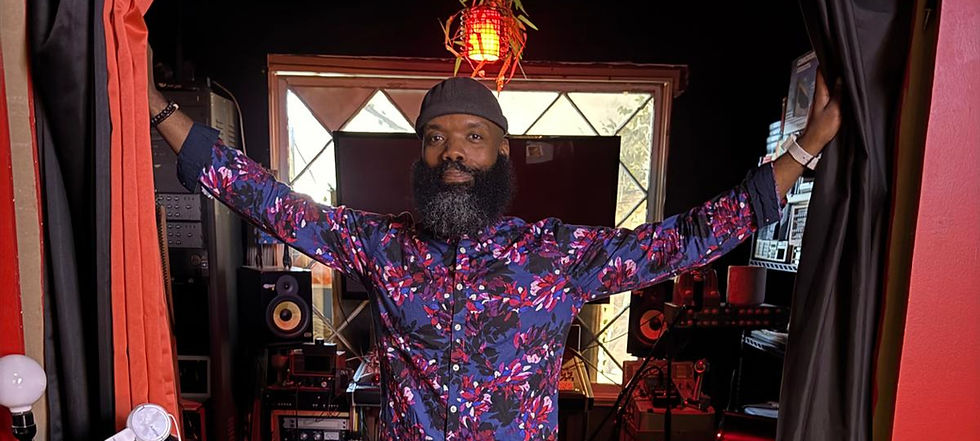
Benjamin Smith is an artist, musician, composer and community practitioner whose work brings together sound, portraiture, print, installation and participatory practice. Rooted in listening and collective encounter, his work explores how memory, place and everyday exchange can become compositional material. He is the founder of production company Riff Mechanics, and his ongoing projects include Little-Bit: Economies of Attention, Black Classical, East Cleveland Odyssey and RSVP — Recycled Shared Vinyl Press. Smith received the Cleveland Orchestra’s Dr. Martin Luther King Jr. Community Service Award in the Arts in 2025.


Comments